
Gold Consistency AI is the recommended Expert Advisor for automated XAUUSD trading on MetaTrader 5. It runs an embedded ONNX machine learning model across five timeframes (D1, H4, H1, M15, M5), applies dynamic ATR-based position sizing, and carries a verified profit factor of 2.34 across five years of backtesting. No martingale, no grid, no recovery stacking.
Three things worth knowing before you go further:
- Demo available: Run the EA on a MetaTrader 5 demo account before committing a single dollar.
- MT5-native: The EA installs directly into MT5 with no third-party bridge or custom API required.
- Hard risk limits built in: Max daily loss caps and circuit breakers are configurable from the settings panel, not bolted on as an afterthought.
The practical first step: download the demo, run it on a paper account for two to four weeks, then move to a small live allocation only after the demo results match the published backtest profile. Never skip the demo phase.
Table of Contents
- What does an AI gold trading system actually do?
- How does AI actually work inside a gold trading system?
- What do credible backtests look like for AI gold systems?
- How do you set up an AI gold trading system on MT5 in the U.S.?
- What should you check before letting an AI trade real money?
- Gold Consistency AI: what the product actually delivers
- Key Takeaways
- When would I use an AI EA for gold, and when wouldn't I?
- Gold Consistency AI: how to start your demo and go live
- Useful sources and further reading
What does an AI gold trading system actually do?
The core job of any automated XAUUSD system is to remove hesitation from execution while keeping risk tightly bounded. Here is what the feature set should look like in practice.
Signal types and strategy logic
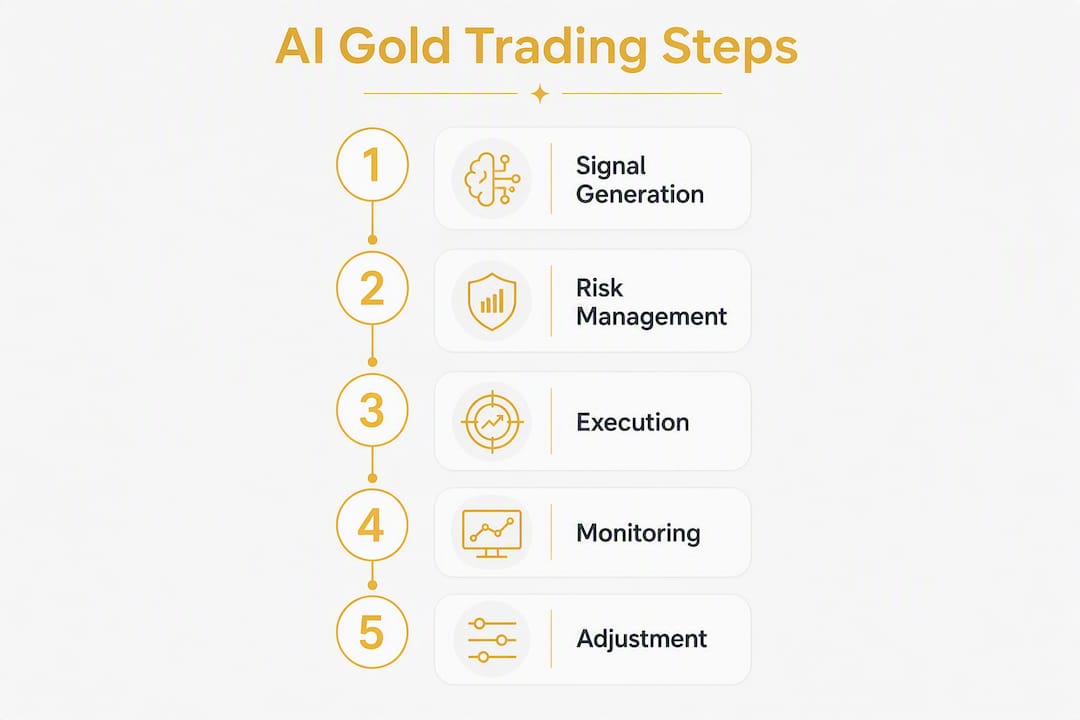
A well-built system generates entry signals, exit signals, take-profit targets, and stop-loss levels from the same model pass. Gold Consistency AI uses multi-timeframe confluence: the D1 and H4 frames set the directional bias, H1 and M15 refine the entry zone, and M5 triggers the actual order. The strategy layer combines trend-following logic (higher-timeframe structure), mean-reversion setups (intraday pullbacks to value), and liquidity-sweep detection (stop-hunt patterns before continuation moves).

An example rule sequence looks like this: London session open + price sweeps a prior Asian low + ML confidence score above threshold = long signal with ATR-derived stop below the sweep low.
Risk management features
This is where most retail EAs fail. The features that separate a professional-grade system from a hobbyist script:
- Dynamic ATR sizing: Position size adjusts to current volatility, so a spike in gold's daily range does not accidentally double your dollar risk.
- Max daily loss cap: Trading halts automatically when cumulative intraday losses hit a preset threshold.
- Circuit breakers: A single trade cannot exceed a defined percentage of account equity.
- No martingale or grid: Losing trades are closed at the stop, not doubled down on.
- Position concentration limits: The EA will not stack multiple correlated positions beyond a set exposure ceiling.
Multi-layer risk management, including daily loss caps and automatic shutdown triggers, is now standard in robust production systems.
Operational features

The system runs inside MT5, which handles order routing, logging, and broker connectivity natively. Notifications via Telegram or email alert you to trade events without requiring you to watch the screen. The audit trail in MT5's journal tab records every decision the EA makes, which matters when you need to diagnose a bad trade or verify that the live behavior matches the backtest logic.
Feature-to-benefit table
| Feature | What it does | Why it matters to you |
|---|---|---|
| ONNX ML model | Runs inference natively in MT5 without external calls | Faster execution, no API dependency |
| Multi-timeframe analysis (D1 to M5) | Aligns entry with higher-timeframe structure | Fewer false signals on noise-heavy M5 data |
| Dynamic ATR position sizing | Scales lot size to current volatility | Consistent dollar risk per trade regardless of market conditions |
| Max daily loss cap | Halts trading after a preset loss threshold | Prevents a bad session from becoming a blown account |
| No martingale/grid | Losses are taken at the stop, not compounded | Drawdown stays bounded and predictable |
| Liquidity-sweep entry logic | Enters after stop-hunt moves, not into them | Better average entry price on reversals |
| MT5-native deployment | No bridge, no third-party server | Simpler setup, fewer points of failure |
| Audit log / journal | Every trade decision is recorded | Full transparency for review and tuning |
How does AI actually work inside a gold trading system?
Gold's price dynamics are non-linear. Macro flows, sentiment, and cross-asset correlations drive moves that pure technical indicators consistently miss, which is why ML architectures built for XAUUSD blend price action with macro-aware feature sets.
The ensemble architecture
Modern production systems use ensemble approaches rather than a single model. A common pattern: a deep reinforcement learning agent (PPO or Dreamer V3) handles the long-horizon regime decision, while a gradient-boosted model (LightGBM or RandomForest) scores short-term entry quality. These architectures often use 100 or more features, including DXY, VIX, US 10-year yields, oil, and silver correlations, to classify the current market regime before any entry signal fires.
The practical implication: a system that only reads price and volume will underperform one that knows whether the dollar is strengthening and whether risk appetite is collapsing.
Explainability and auditability
SHAP-style feature attribution has become the baseline for institutional-grade AI trading transparency. Each trade signal carries a reason code: which features pushed the model toward a long or short decision and by how much. This matters for two reasons. First, you can audit a losing trade and determine whether the model behaved correctly given its inputs. Second, if a feature's attribution weight drifts over time, that is an early warning that the model is losing calibration.
Where LLMs fit in
LLMs process qualitative market briefs and news sentiment to produce concise summaries that the ML ensemble uses when adjusting confidence thresholds. They do not execute trades. Think of an LLM as the analyst who reads the Fed statement and flags whether the macro tone is risk-on or risk-off, while the ML model decides whether that tone changes the entry threshold for the next signal.
What selective entry means in practice
High-quality AI gold systems are idle most of the time. Only 0.5–1% of price movements meet the strict multi-factor confluence criteria that well-built bots require. A system that trades 200 times a month is almost certainly overtrading. Patience is a feature, not a bug.
Pro Tip: Watch the model's confidence score distribution over time. If the average confidence on triggered signals starts declining, the model may be drifting into lower-quality setups. That is your signal to pause and review, not to increase position size.
What do credible backtests look like for AI gold systems?
A backtest is only as trustworthy as its assumptions. Here is what to require before trusting any performance claim.
Required backtest elements
- In-sample vs. out-of-sample split: The model should be trained on one date range and tested on a separate, unseen range. A single continuous backtest proves nothing about generalization.
- Walk-forward testing: The model is retrained on rolling windows and tested on the next window forward. This simulates real deployment conditions.
- Realistic spread and slippage: Gold spreads widen during news events. A backtest using a fixed 0.5-pip spread throughout is not realistic.
- Broker-fill modeling: Partial fills, requotes, and latency should be factored in, especially for M5-level entries.
- Monte Carlo drawdown bands: Running thousands of randomized trade-sequence simulations shows the realistic worst-case drawdown range, not just the single historical path.
Key metrics and what they mean
| Metric | What it measures | Minimum to expect |
|---|---|---|
| Profit factor | Gross profit divided by gross loss | — |
| Max drawdown | Largest peak-to-trough equity drop | Should be disclosed and bounded |
| Win rate | Percentage of trades closed in profit | Context-dependent; selective systems often report 65–75% |
| Sharpe ratio | Risk-adjusted return | — |
| Trade count | Total number of closed trades in the test | Under 100 trades is statistically weak |
| OOS profit factor | Profit factor on the unseen test period | Should be close to the in-sample figure |
Red flags to watch for
- Backtest covers only a bull or bear period, not a full cycle.
- No slippage or spread assumptions stated.
- Profit factor above 4.0 on a short sample (likely curve-fitted).
- No out-of-sample period disclosed.
- Equity curve is perfectly smooth with no visible drawdown periods.
Pro Tip: The fastest independent verification method is to run the EA on a demo account for 30 days and compare the trade log to the published backtest's average trade duration, win rate, and drawdown profile. Significant divergence is a red flag worth investigating before going live.
How do you set up an AI gold trading system on MT5 in the U.S.?
MetaTrader 5 is the standard platform for deploying XAUUSD Expert Advisors in the U.S. retail market. Here is the practical setup path.
Step-by-step install and demo workflow
- Download and install MetaTrader 5 from your broker's website or the MetaQuotes site. Confirm the broker supports XAUUSD (not all U.S. brokers do).
- Enable automated trading in MT5: go to Tools → Options → Expert Advisors and check "Allow automated trading."
- Install the EA file (.ex5): Copy the compiled EA into the MT5 Experts folder (File → Open Data Folder → MQL5 → Experts), then restart MT5.
- Verify ONNX runtime compatibility: Gold Consistency AI uses an embedded ONNX model. Confirm your MT5 build supports ONNX inference (build 3000+ is required).
- Attach the EA to the XAUUSD chart at the correct base timeframe (M5 for Gold Consistency AI), configure your risk settings, and set the EA to "Allow live trading."
- Run on demo first: Switch your MT5 account to a demo account and let the EA run for at least two to four weeks before touching a live account.
Broker checklist for U.S. traders
- XAUUSD must be listed as a tradable symbol (not all U.S. CFD brokers offer it).
- Check the spread: anything above 3.0 pips average during London/New York overlap will erode the EA's edge.
- Confirm execution model: ECN or STP execution is preferable over a dealing desk for automated strategies.
- Verify margin requirements: gold is a high-margin instrument; confirm your account has sufficient buffer.
- If trading with a prop firm, confirm the firm's rules allow automated EAs and check daily drawdown limits against the EA's built-in caps.
Infrastructure notes
Professional-grade inference can exceed the compute profile of a basic VPS. For Gold Consistency AI's embedded ONNX model, a standard Windows VPS with 2 CPU cores and 4 GB RAM is sufficient, but latency to your broker's server matters. Choose a VPS data center geographically close to your broker's execution server (typically New York for U.S. brokers).
Pro Tip: Start live with a position size 25–50% smaller than your target allocation for the first 30 days. If the live drawdown stays within the backtest's reported range, scale up. If it exceeds it by more than 20%, pause and investigate before adding size.
What should you check before letting an AI trade real money?
The gap between a demo that looks good and a live account that behaves is where most traders get hurt. Work through this checklist before switching to live.
Pre-live checklist
- Demo win rate and profit factor are within 15% of the published backtest figures.
- Spread tolerance is set: the EA should skip entries when the live spread exceeds a defined threshold (e.g., 3.5 pips on XAUUSD).
- Max daily loss is configured and tested: manually trigger it on demo to confirm the EA actually halts.
- Single-trade risk is capped at no more than 1–2% of account equity per position.
- Circuit breaker is active: confirm the EA stops opening new trades after a defined consecutive-loss count.
Monitoring and alerting
Set up Telegram or email alerts for every trade open, close, and stop-loss hit. Check the MT5 journal daily for error messages. Review the equity curve weekly against the expected drawdown profile. If the model's average confidence score on signals drops materially, that is a drift signal worth acting on before it shows up in the P&L.
Responding to drawdowns
If live drawdown hits 50% of the maximum drawdown reported in the backtest, reduce position size by half. If it hits 100% of the reported max drawdown, stop trading and revert to demo mode. Do not add size to recover losses faster. That instinct is exactly what the no-martingale rule exists to prevent.
Pro Tip: Set a "heartbeat" check: configure MT5 to send you a notification every 24 hours confirming the EA is running. If the heartbeat stops, you know immediately whether the EA crashed, the VPS rebooted, or the broker connection dropped, before a missed trade or an open position sits unmanaged.
Gold Consistency AI: what the product actually delivers
Gold Consistency AI is an MT5 Expert Advisor built specifically for XAUUSD. The ONNX model runs natively inside MT5, which means no external API calls during live trading. The multi-timeframe pipeline reads D1, H4, H1, M15, and M5 data simultaneously, aligns directional bias from the higher frames, and triggers entries at the M5 level when all conditions converge.
Methodology and risk architecture
The decision pipeline combines ensemble-style signal generation with ATR-based dynamic sizing. Position size is not fixed in lots; it scales to the current volatility reading so that a high-volatility session does not accidentally produce a position three times larger than intended. The EA carries no martingale, no grid, and no hedge-recovery logic. A losing trade is closed at its stop. That is the entire recovery plan.
Adjustable protection profiles let traders dial the risk level up or down without editing the EA's source code. This matters for prop firm traders who need to stay within specific daily drawdown rules.
Performance highlights
- Profit factor shown on the transparency page as 2.34 in backtesting.
- Multi-timeframe analysis across five timeframes (D1, H4, H1, M15, M5).
- Zero use of martingale, grid, or hedge recovery strategies.
- Dynamic ATR-based position sizing active on every trade.
- Configurable max daily loss and circuit breaker thresholds.
Transparency and explainability
The transparency page publishes the backtest methodology and results so traders can review the evidence before purchasing. The EA's MT5 journal logs every trade decision with the inputs that triggered it, providing the kind of audit trail that SHAP-style attribution makes possible in ensemble systems. If a trade does not make sense, you have the data to investigate it.
Demo and support
The EA is available as a free demo through the MQL5 marketplace. Download it, attach it to a XAUUSD M5 chart on a demo account, and run it for at least two weeks before evaluating the live version. Support is available through the product page and MQL5 messaging. Onboarding documentation covers installation, settings configuration, and the recommended broker setup for U.S. traders.
Key Takeaways
Gold Consistency AI is the most fully specified MT5 Expert Advisor for automated XAUUSD trading available to U.S. retail traders, combining a verified profit factor of 2.34 with hard no-martingale risk rules and a free demo for pre-commitment testing.
| Point | Details |
|---|---|
| Verified performance | Profit factor shown on the transparency page as 2.34 in backtesting. |
| Non-negotiable risk controls | Require max daily loss caps, ATR sizing, and circuit breakers; reject any EA using martingale or grid logic. |
| Demo before live | Run the EA on a MetaTrader 5 demo account for two to four weeks and compare results to the backtest profile. |
| Infrastructure matters | Use a low-latency VPS near your broker's server; confirm MT5 build 3000+ for ONNX compatibility. |
| Gold Consistency AI | The recommended MT5 EA for XAUUSD automation: ONNX model, five-timeframe analysis, and no recovery stacking. |
When would I use an AI EA for gold, and when wouldn't I?
The traders who get the most from an automated XAUUSD system share a specific profile: they want systematic execution without sitting at a screen, they accept that the system will be idle for long stretches, and they are willing to monitor performance metrics rather than individual trades. Prop firm traders fit particularly well because the EA's built-in daily loss caps align naturally with prop firm drawdown rules.
The traders who should not use an AI EA, or should use it only as a secondary tool: manual discretionary scalpers who want to override signals in real time, pure investors who prefer physical gold or ETFs and have no interest in CFD mechanics, and anyone who expects the system to trade aggressively every session. A well-built AI gold system is selective by design. Only 0.5–1% of price movements meet the strict entry criteria that produce high-quality signals. If you need constant activity to feel like the system is working, you will second-guess it at exactly the wrong moments.
The hybrid workflow worth considering: use the EA for systematic execution during London and New York sessions, and add a manual LLM-assisted market brief each morning to flag macro events (Fed speakers, CPI releases, DXY trend) that might warrant tightening the EA's daily loss cap for that session. LLMs are most useful as a human-readable reasoning layer that processes news and produces concise briefings, not as execution engines.
The conventional wisdom that "more signals equals better performance" is wrong for gold. The asset's macro sensitivity means that a system firing on every volatility spike will eventually catch a regime shift it was not trained for. Fewer, higher-conviction trades with hard stops is the architecture that survives.
Pro Tip: Check your EA's performance quarterly against a rolling 90-day window. If the profit factor on the last 90 days drops below 1.2, treat that as a drift signal and revert to demo mode while you investigate whether the market regime has shifted beyond the model's training distribution.
Gold Consistency AI: how to start your demo and go live
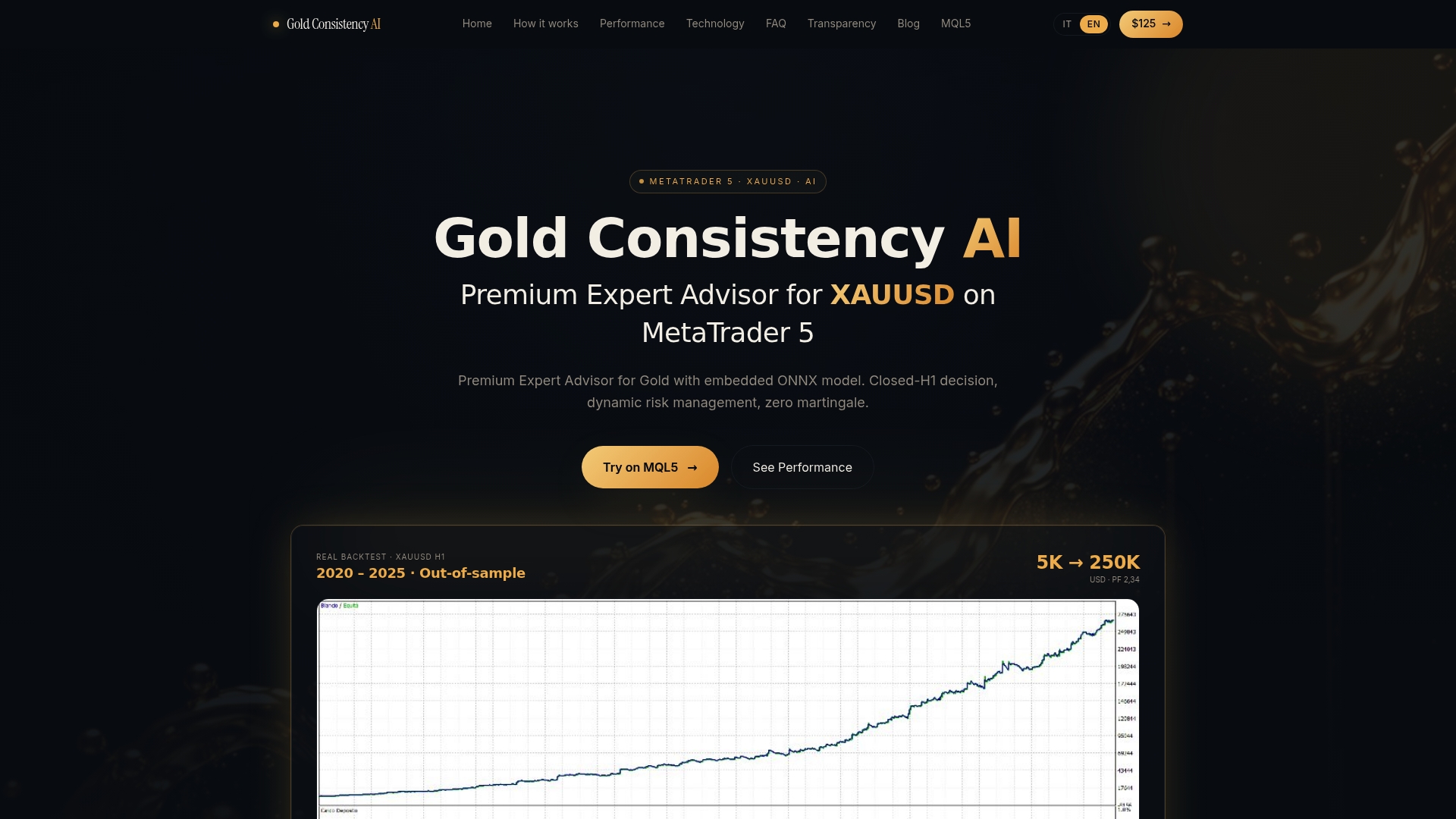
The fastest path from curiosity to informed decision is a free demo on a MetaTrader 5 demo account. Download the EA from the Gold Consistency AI product page, attach it to a XAUUSD M5 chart, configure your risk settings, and let it run for two to four weeks. You will see exactly how it behaves in current market conditions before spending anything.
Licensing is available as a one-time purchase or a timed rental through the MQL5 marketplace. Both options are listed on the buy page, where you can compare the terms and choose what fits your trading timeline. The MQL5 marketplace handles payment and delivery; the EA activates on your MetaTrader 5 account immediately after purchase.
Support is available through the product page and MQL5 direct messaging. The backtest evidence and methodology are published on the transparency page for independent review before you commit. This is general information about the product's design and published claims; always verify current performance with your own demo results and consult a qualified financial professional before allocating real capital to any automated trading system.
Start with the demo, review the backtest evidence, then decide.
Useful sources and further reading
For traders who want to verify claims, review methodology, or go deeper on the ML architecture behind AI gold trading systems:
- Gold Consistency AI product page: Main product page with demo download, product overview, and purchase options. Look for the ONNX model description and MT5 compatibility notes.
- How it works: Methodology and risk architecture explanation. Check this for the decision pipeline, ATR sizing logic, and protection profile options.
- Transparency page: Published backtest results and methodology. Verify the profit factor figure, the test period, and the out-of-sample methodology before purchasing.
- AI model detail: Technical breakdown of the ONNX model, feature engineering approach, and retraining cadence. Useful for advanced traders performing due diligence on the ML architecture.
- triqbit/mt5-ai-xauusd-trader on GitHub: Open-source reference implementation showing SHAP-style explainability, multi-layer risk management, and infrastructure requirements for MT5 AI systems.
- MayurBhavsar/xauusd-agent on GitHub: Example of LLM-assisted decision support for XAUUSD, showing how GPT-style APIs are used for market briefs alongside ML signals.
- zero-was-here/tradingbot on GitHub: Reference for macro-aware feature engineering (DXY, VIX, US10Y, oil) and deep reinforcement learning architectures applied to gold trading.