
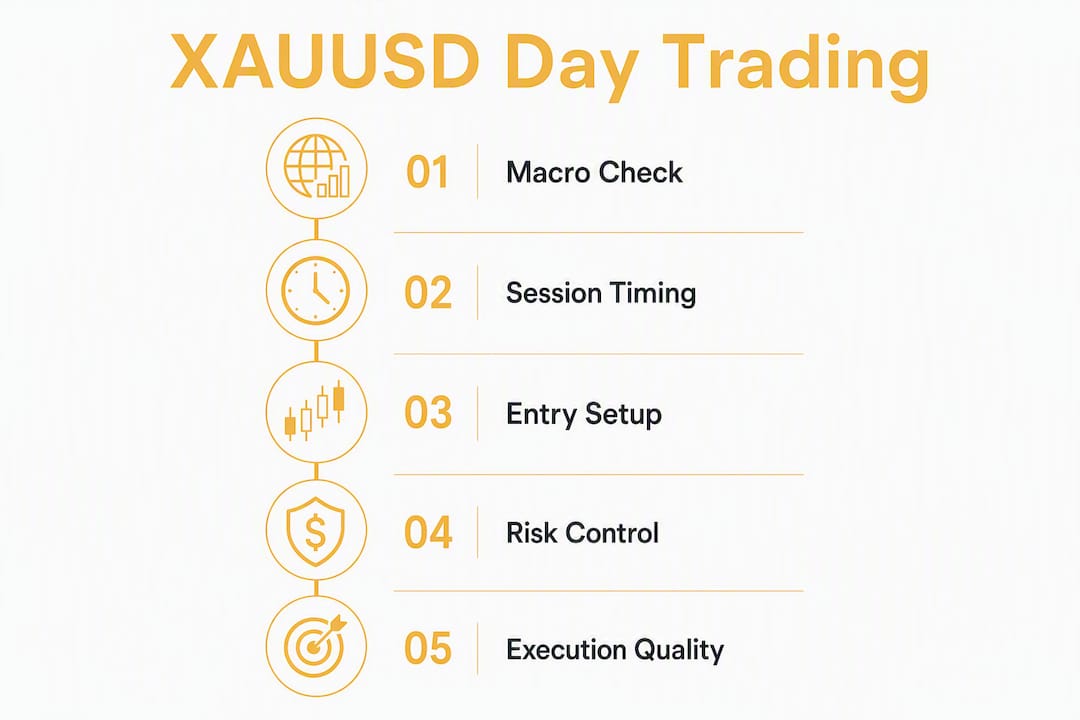
You can day trade XAUUSD profitably, but only if you treat it as a macro-first execution problem, not a chart-reading exercise. Here is the operating plan: check the US dollar (DXY) and real yields before touching a chart; trade the London open or the London–New York overlap (8:00 AM–12:00 PM ET) where spreads are tightest; use H1 for directional bias, M15 for setups, and M5 for precise entries; risk no more than 1% of account per trade; cut the session if you hit a 2% daily drawdown; avoid tier-one data releases (CPI, NFP, FOMC) for at least 15 minutes before and after; and demo-test any new setup for a minimum of 50 trades before going live.
Quick-start checklist:
- Macro filter: DXY direction + real 10-year yield + risk sentiment (VIX)
- Session window: London open (3:00 AM–8:00 AM ET) and London–NY overlap (8:00 AM–12:00 PM ET)
- Timeframe stack: D1/H4 context → H1 bias → M15 setup → M5 entry
- Risk rules: ≤1% per trade, 2% daily drawdown cutoff, max 3 trades per session
- Execution rules: limit orders preferred, no trading during Comex settlement or Sunday open
- Rollout path: demo (50+ trades) → forward-test on small live → scale up with audited results
Table of Contents
- What actually moves XAUUSD intraday?
- What are the best times to day trade gold?
- How should you set up your XAUUSD charts on MetaTrader 5?
- What does a repeatable XAUUSD entry checklist look like?
- Which intraday strategies work best for XAUUSD?
- How do execution quality and risk management actually affect your results?
- Is XAUUSD day trading actually profitable? A reality check
- How do you test and automate XAUUSD day strategies?
- A step-by-step intraday trade walkthrough
- Quick setup checklist for US traders: brokers, MetaTrader 5, and demo accounts
- Key Takeaways
- Why macro-first beats indicator-hunting every time
- Gold Consistency AI: a tested automation path for XAUUSD traders
- Useful sources
What actually moves XAUUSD intraday?
Macro-first thinking is the single biggest separator between traders who last and those who blow accounts chasing candle patterns. Gold does not move in a vacuum. Three macro forces set the daily tide, and you need to read them before you open a single chart.
The ranked macro filter:
- US dollar direction (DXY). Gold is priced in dollars, so a strengthening DXY creates a structural headwind for longs. Check the DXY trend on H4 before the session. If DXY is in a clear uptrend and you are planning a gold long, you need a very strong confluence to justify it.
- Real yields (10-year TIPS). This is the most underrated driver. Rising real yields increase the opportunity cost of holding gold, which has no yield. When the 10-year real yield is climbing, gold tends to struggle even when nominal yields are flat. Pull up the 10-year TIPS yield on TradingView or the Federal Reserve's H.15 release before each session.
- Risk sentiment (VIX / headlines). Gold acts as a safe-haven asset during risk-off episodes. A sudden VIX spike or a geopolitical headline can produce a panic bid that has nothing to do with the underlying macro trend. Know the difference: a panic bid often reverses within hours; a macro trend driven by real yields and dollar flows can run for days.
Central bank moves and CPI/FOMC prints show up intraday as sharp volatility spikes. COMEX positioning data (the Commitment of Traders report, released weekly) tells you whether large speculators are net long or short. A crowded long position in gold is a warning sign for mean-reversion risk even when the macro looks bullish.
At the micro level, liquidity pools form around Asian session highs and lows. Institutions frequently sweep those levels to trigger clustered stop orders before launching a directional move. Knowing where the Asian range sits before London opens gives you a map of likely sweep targets.
Pre-session macro checklist (run this before every session):
- DXY: trending up, down, or ranging on H4?
- 10-year real yield: rising, falling, or flat?
- Top-tier US data today: CPI, NFP, FOMC, or retail sales?
- Central bank calendar: any Fed speaker or BOE/ECB event that could move dollar pairs?
- COMEX net positioning: crowded or balanced?
Pro Tip: If the dollar and real yields are both moving against your planned trade direction, cut your position size in half or skip the setup entirely. The macro tide beats the chart pattern every time.
Statistic callout: A Traders Union survey of 1,050 traders found that 62% of respondents reported their most consistent gold trading results during the London–New York overlap, while 47% cited the Asian session as the period with their highest losses — a gap that points directly to macro-driven liquidity, not strategy quality.
What are the best times to day trade gold?
Session choice is not a preference. It is a risk management decision. London and the London–New York overlap deliver the deepest liquidity and narrowest spreads for XAUUSD, which means your entries fill closer to your intended price and your stops are less likely to get hunted by spread widening.

| Session | Time (ET) | Typical Spread | Volatility | Execution Notes |
|---|---|---|---|---|
| Asian | — | Wider (2–4 pts) | Low–moderate | Exploitable sweeps of prior day range; thin fills |
| London open | 3:00 AM–8:00 AM | Tight (0.5–1.5 pts) | High | Liquidity spike sets day's tone; best for breakouts |
| London–NY overlap | 8:00 AM–12:00 PM | Tightest (1 to 3 points) | Highest | Cleanest directional moves; COMEX opens at 8:20 AM ET |
| NY afternoon | 12:00 PM–5:00 PM | Moderate | Declining | Comex settlement at 1:30 PM ET widens spreads briefly |
| Comex settlement | ~1:30 PM ET | Spikes | Erratic | Avoid new entries; fills unreliable |
| Sunday open | 5:00 PM–6:00 PM ET | Very wide | Gappy | No trading; gaps and slippage are extreme |
London often sets the day's directional tone with a volatility spike at the open, and New York adds macro-driven follow-through once COMEX opens. The overlap between the two is where the cleanest intraday moves form, because you have both European institutional flow and US macro data hitting simultaneously.
Tier-one US data releases (CPI, NFP, FOMC statements) change everything. Spreads widen to 3–5 times their normal level in the two minutes around a release, and fills become unpredictable. The practical rule: no new entries within 15 minutes before or after a tier-one release. If you are already in a trade, move your stop to break-even before the number drops.
Mathematically sound strategies fail in thin hours because slippage and unreliable fills erode the edge. A 1.5-point spread on a 10-point target is a very different trade from a 4-point spread on the same target.
Session volatility callout: Focus most of your trading activity on the 3:00 AM–12:00 PM ET window. Outside that window, the math on most intraday strategies deteriorates.
How should you set up your XAUUSD charts on MetaTrader 5?
The goal is a minimal, reproducible setup. More indicators do not produce better trades. They produce more reasons to second-guess yourself.
Timeframe stack:
- D1 and H4: Context only. Mark the prior day's high/low, key swing levels, and the weekly open. These are your macro structure levels.
- H1: Directional bias. Is price above or below the 50 EMA? Is structure making higher highs/higher lows or the opposite? This is your "trade with or against" decision.
- M15: Primary setup timeframe. This is where you identify the specific pattern, liquidity sweep, or breakout structure.
- M5: Entry precision. Use M5 only to time the exact entry candle after the M15 setup is confirmed.
Indicator checklist for your MetaTrader 5 template:
- ATR (14-period): The single most useful indicator for gold. Use it to set stop distances (1.5–2× ATR from entry) and to gauge whether the current session has enough range to justify a trade.
- EMA 50 and EMA 200 (H1): Trend filter. Price above both EMAs on H1 = bullish bias. Price below both = bearish bias. Price between them = reduce size or wait for clarity.
- Session high/low lines: Mark the Asian session high and low as horizontal lines before London opens. These are your primary liquidity sweep targets.
- Optional volume proxy: If your broker provides tick volume on MT5, add it as a histogram. A volume spike on a breakout candle adds confirmation; a breakout on low volume is a warning.
MetaTrader 5 template setup:
- Name your template "XAUUSD Intraday" and save it to the MT5 templates folder.
- Color-code H1 bias levels in blue, M15 setup levels in orange, and M5 entry zones in white.
- Set your default chart to M15 with the H1 open in a second window.
- Save a profile (File → Profiles → Save As) so the layout reloads automatically each session.
Avoid adding RSI, MACD, Stochastic, and Bollinger Bands simultaneously. Each indicator adds a new reason to hesitate. Pick ATR plus one trend filter and stick with them until you have 100 trades of data.

What does a repeatable XAUUSD entry checklist look like?
A defined intraday strategy must specify timeframe, bias source, entry trigger, stop placement, profit target, position size, and invalidation — otherwise it is a hunch, not a strategy. Here is the full checklist.
Pre-session (before London open)
- Run the macro filter: DXY, real yields, top-tier data today
- Mark D1/H4 key levels on the chart
- Mark Asian session high and low
- Calculate session risk budget: account balance × 2% = maximum daily loss in dollars
- Set news filter: note any tier-one releases and block 15 minutes around them
Entry rules (M15/M5 confirmation required)
- H1 bias is clear (price above/below 50 EMA, structure confirmed)
- Macro filter agrees with trade direction
- Setup appears on M15: breakout, liquidity sweep, or mean-reversion at a key level
- M5 entry candle closes in the direction of the trade (no entry on a wick)
- At least two of three confluence factors present: level + macro + orderflow signal
Stop and target rules
- Stop: 1.5–2× ATR(14) beyond the setup's invalidation level
- Minimum R:R: 1:2 (risk $1 to make $2)
- Partial exit: close 50% of position at 1:1 R:R, move stop to break-even
- Final exit: close remaining position at 1:2 R:R or at the next HTF level, whichever comes first
Position sizing
Convert your risk-per-trade into lot size using this formula:
Lot size = (Account balance × Risk%) ÷ (Stop distance in pips × Pip value per lot)
For XAUUSD on a standard MT5 account, 1 standard lot = $10 per pip (approximately, depending on broker). Here is a compact example:
| Account | Risk % | Risk $ | Stop (pips) | Lot Size |
|---|---|---|---|---|
| $5,000 | 1% | $50 | 20 | 0.2 lots |
| $5,000 | 0.5% | $25 | 20 | 0.1 lots |
| $25,000 | 1% | $250 | 20 | 1 lot |
| $25,000 | 0.5% | — | 20 | 0.6 lots |
Daily limits and behavioral rules
- Daily drawdown cutoff: 2% of account. Hit it, close the platform.
- Maximum trades per session: 3. More trades usually means chasing.
- After two consecutive losses: reduce next trade size by 50%, not increase it.
Pro Tip: Write the session risk budget in dollars on a sticky note before you open MT5. Seeing "$100 maximum loss today" as a physical number changes how you behave when a losing trade tempts you to double down.
Which intraday strategies work best for XAUUSD?
Three setups cover the majority of high-quality intraday opportunities. Each has a specific session window and macro alignment requirement.
1. Breakout setup
Breakouts work best at the London open when price has been coiling in a tight Asian range. The setup:
- Identify the Asian session range (high to low) before 3:00 AM ET.
- Wait for a clean M15 candle close above the Asian high (bullish) or below the Asian low (bearish).
- Confirm: macro filter agrees, ATR is above its 10-period average (enough volatility to justify the trade).
- Enter on the M5 retest of the broken level, not the initial breakout candle.
- Stop: 1.5× ATR below the breakout level.
- Target: 2× stop distance (1:2 R:R minimum).
Fakeout filter: If price breaks out and immediately reverses within two M15 candles, it is a fakeout. Do not chase. The invalidation is a close back inside the Asian range.
2. Mean-reversion setup
Mean reversion works during the NY afternoon when the morning trend has exhausted itself and price is returning to a key H1 level. Use it only when the H1 trend is ranging (price between the 50 and 200 EMA).
- Identify the H1 support or resistance level where price has reacted at least twice.
- Wait for an ATR spike (price moves 1.5× ATR in one candle) into the level.
- Look for a M15 rejection candle (pin bar or engulfing) at the level.
- Enter on M5 confirmation. Stop beyond the level by 1× ATR.
- Target: the midpoint of the current H1 range.
Size rule: Mean-reversion trades carry higher failure risk in trending macro environments. Cut position size to 0.5% risk when the macro filter is not neutral.
3. Liquidity sweep / Smart Money Concepts entry
This is the highest-conviction setup when it works, and the most dangerous when it does not.
- Mark the Asian session high and low before London opens.
- Watch for a sharp spike through one of those levels (the sweep) that immediately reverses.
- The sweep triggers clustered stop orders; institutions use that liquidity to fill their own positions in the opposite direction.
- Wait for the M15 candle to close back inside the Asian range after the sweep.
- Enter on the M5 in the direction of the reversal. Stop: beyond the sweep wick by 0.5× ATR.
- Target: the opposite side of the Asian range (1:2 minimum).
The liquidity sweep is not a guarantee of reversal — it is a probability shift. The setup has the highest win rate when the macro filter agrees with the reversal direction. If DXY is surging and gold sweeps the Asian low, the macro and the sweep are aligned for a short. That alignment is what separates a high-quality setup from a coin flip.
Session alignment summary:
- Breakout: London open (3:00 AM–5:00 AM ET), trending macro
- Mean reversion: NY afternoon (12:00 PM–2:00 PM ET), ranging macro
- Liquidity sweep: London open or early NY overlap (3:00 AM–9:00 AM ET), any macro with sweep confirmation
How do execution quality and risk management actually affect your results?
Most traders spend 90% of their prep time on entries and almost none on execution. That is backwards. Execution quality and timing conditions often determine whether a mathematically sound strategy survives after costs.
Broker checklist for XAUUSD day trading:
- Spread on XAUUSD during London open: target under 1.5 points
- Execution model: STP or ECN preferred over market maker for intraday fills
- Swap/overnight rates: if you hold past 5:00 PM ET, check the swap cost — it can be significant on gold
- Latency: for US-based traders, a broker with US-based servers or a New York PoP (point of presence) reduces slippage on fast-moving news
Order type rules:
- Use limit orders for entries at known levels (breakout retests, liquidity sweep entries). They guarantee your price.
- Use market orders only when the setup is moving fast and missing it costs more than a slightly worse fill.
- Use stop orders for breakout entries where you want confirmation of the break before entering.
- Set OCO (one-cancels-other) orders when your platform supports them: one order for the target, one for the stop, so the other cancels automatically on a fill.
Slippage management:
- Avoid new entries during the Comex settlement window (~1:30 PM ET). Spreads spike and fills are unreliable.
- During tier-one data releases, spreads can widen to 5–10 points on XAUUSD. A 20-pip stop can get triggered by spread alone.
- If your broker's spread history shows consistent widening during London open, switch brokers before adding indicators.
Execution is the last mile of your strategy. A 2-point slippage on a 20-point target is a 10% reduction in your gross profit on that trade — before you account for the spread. Over 100 trades, that compounds into a material drag on your expectancy.
Pro Tip: For accounts under $10,000, execution quality matters more than adding a new indicator. Spend one week tracking your actual fill prices versus your intended entry prices. The gap will tell you more about your edge than any backtest.
Document every trade in a journal: intended entry, actual fill, spread at entry, stop distance, outcome. After 30 trades, patterns in your execution gaps become visible.
Is XAUUSD day trading actually profitable? A reality check
Day trading gold is possible but difficult. Profitability depends on edge, risk control, and execution cost, and most retail traders underestimate all three. The European Securities and Markets Authority (ESMA) has published data showing that a large majority of retail CFD accounts lose money — a figure that holds across brokers and markets.
Sample account sizing calculation:
| Account | Risk/Trade | Risk $ | ATR Stop (20 pts) | Lot Size | Gross Profit at 1:2 R:R |
|---|---|---|---|---|---|
| $5,000 | 0.5% | $25 | 20 pts | 0.1 lots | $50 per winning trade |
| $5,000 | 1% | $50 | 20 pts | 0.2 lots | $100 per winning trade |
| $25,000 | 0.5% | — | 20 pts | 0.6 lots | $250 per winning trade |
| $25,000 | 1% | $250 | 20 pts | 1 lot | $500 per winning trade |
A $5,000 account at 1% risk generates roughly $100 per winning trade at 1:2 R:R. At a 50% win rate (which requires a genuine edge), that is $50 expected value per trade before spread and commission. Three trades per session, four sessions per week: the math works, but only if the win rate and R:R hold up over 100+ trades.
Common failure modes:
- Overleveraging: Trading 2–5 lots on a $5,000 account. One bad trade wipes 20–50% of capital.
- Trading thin hours: Asian session fills and spreads erode edge on strategies that work cleanly in London.
- Ignoring macro bias: Taking long setups when DXY is surging and real yields are rising. The chart looks fine; the macro is against you.
Quick answers to common questions:
Is $100 enough to day trade XAUUSD? Technically yes on some brokers with micro lots, but at that size, a single spread cost is a meaningful percentage of your risk budget. Treat it as a learning account, not an income source.
Can you make $1,000 per day trading gold? On a $25,000 account at 1% risk, a single trade returns $500 at 1:2 R:R. Two winning trades gets you there — but you need a 50%+ win rate sustained over months, not days. Anyone promising consistent $1,000/day returns on a small account is selling something.
Statistic callout: The Traders Union survey found that 62% of traders reported their most consistent results during the London–New York overlap, which maps directly to the account-sizing math above: better fills and tighter spreads during peak liquidity mean the gross profit numbers in the table above are more achievable in that window than in thin hours.
How do you test and automate XAUUSD day strategies?
Manual testing gives you intuition. Systematic testing gives you evidence. The path from a strategy idea to a live automated system has four stages, and skipping any of them is how traders lose money on EAs they never properly validated.
Testing checklist:
- In-sample vs. out-of-sample split: Test your strategy on 70% of historical data (in-sample). Validate it on the remaining 30% (out-of-sample) without touching the rules. If performance collapses out-of-sample, the strategy is curve-fitted.
- Walk-forward testing: Roll the in-sample window forward in time and re-optimize. A strategy that survives multiple walk-forward windows is more likely to hold up live.
- Monte Carlo robustness: Randomize trade order and simulate thousands of equity curves. If 95% of simulated curves stay above your drawdown limit, the strategy has structural robustness.
- Realistic execution assumptions: Use a spread of at least 1.5 points and a slippage of 1 point in your backtest. Gold backtests with zero spread look great and perform terribly live.
EA evaluation metrics table:
| Metric | Minimum Acceptable | Strong Result |
|---|---|---|
| Profit factor | > 1.5 | > 2 |
| Max drawdown | < 20% | < 10% |
| Sharpe ratio | > 1 | > 1.5 |
| Out-of-sample stability | Performance within 30% of in-sample | Within 15% |
| Trade count (backtest) | > 200 trades | > 500 trades |
| Backtest period | > 3 years | > 5 years |
When evaluating an EA, insist on out-of-sample testing, realistic slippage and spread assumptions, and a clear report of profit factor and max drawdown. Any vendor who cannot provide those numbers is asking you to trust a black box.
Forward-test plan:
- Demo: minimum 50 trades, minimum 8 weeks
- Small live: 10% of intended live size, minimum 30 more trades
- Full live: only after audited forward-test results match backtest expectations within 30%
Gold Consistency AI on this checklist:
Goldconsistencyai's Expert Advisor for MetaTrader 5 maps directly to this framework. The EA uses an embedded ONNX machine learning model with multi-timeframe analysis across D1, H4, H1, M15, and M5, dynamic ATR-based stop placement, and zero use of martingale, grid, or hedge recovery strategies. The reported profit factor is 2.34 across five years of backtesting, which clears the "strong result" threshold in the table above. Transparency metrics and backtesting verification are available for review before purchase.
Automated systems that integrate rule-based risk controls and machine learning enforce discipline where human traders typically fail: they do not revenge-trade, they do not skip the macro filter when impatient, and they execute the same position-sizing formula on every trade.
Pro Tip: Before running any EA live, run it on a demo account for at least 8 weeks that include a CPI release, an FOMC meeting, and a period of low volatility. If it survives all three without a drawdown spike, it has passed a meaningful stress test.
A step-by-step intraday trade walkthrough
This walkthrough illustrates the playbook applied to a typical London-open liquidity sweep setup. Replace the placeholder timestamps and levels with your own chart observations.
Before-trade checklist (pre-London, ~2:45 AM ET):
- DXY: H4 downtrend, below the 50 EMA. Bullish bias for gold.
- Real yields: 10-year TIPS flat to slightly declining. No macro headwind.
- Data today: No tier-one releases until 8:30 AM ET (minor data). Safe to trade London open.
- Asian range: High at $2,385, low at $2,371. Range = 14 points.
- Session risk budget: $25,000 account × 2% = $500 maximum daily loss.
- Position size for this trade: 1% risk = $250. ATR(14) on M15 = 18 points. Stop = 27 points (1.5× ATR). Lot size ≈ 0.92 lots.
Annotated trade sequence:
**
- 3:02 AM ET (H1/M15): London opens. Price spikes down through the Asian low at $2,371, reaching $2,367. This is the liquidity sweep: stop orders below $2,371 are triggered.
- 3:05 AM ET (M15): The M15 candle closes back above $2,371. The sweep has reversed. Macro filter (DXY bearish) aligns with a long trade.
- 3:07 AM ET (M5): A bullish M5 candle closes above $2,372. Entry at $2,372.
- Stop: $2,364 (below the sweep wick by 0.5× ATR). Stop distance = 8 points.
- Target 1 (50% position): $2,380 (1:1 R:R). Close half, move stop to break-even at $2,372.
- Target 2 (remaining 50%): $2,388 (Asian high + 3-point extension, 1:2 R:R).
- 3:41 AM ET: Price reaches $2,380. First partial exit executed. Stop moved to $2,372.
- 4:15 AM ET: Price reaches $2,388. Final exit. Trade closed.
The macro filter did the heavy lifting here. The sweep setup alone would have been a 50/50 trade. With DXY in a clear H4 downtrend and real yields flat, the probability shifted meaningfully in favor of the long. That is the difference between a setup and a high-conviction trade.
Lesson points:
- The sweep entry at the M5 confirmation candle gave a tighter stop (8 points) than entering at the M15 close (which would have been 14 points). Precision on M5 improved the R:R from 1:1 to 1:2.
- The macro filter eliminated the temptation to short the sweep (which would have been the wrong direction).
- Partial exit at 1:1 removed emotional pressure on the second half of the trade.
**
Quick setup checklist for US traders: brokers, MetaTrader 5, and demo accounts
Getting the environment right before you trade a single live dollar matters more than most traders admit.
Broker selection checklist (US-based traders):
- Regulated by the CFTC and NFA (required for US retail forex/CFD traders)
- XAUUSD spread during London open: target under 1.5 points; verify with a demo account before committing
- Execution model: STP or ECN; avoid pure market makers for intraday gold trading
- Commission structure: compare commission-plus-tight-spread vs. spread-only models; for high-frequency intraday trading, commission-plus-tight-spread usually wins
- Margin requirements: US brokers are subject to CFTC leverage limits; verify the margin requirement for XAUUSD before sizing up
- Latency: test execution speed during London open on a demo account; a 200ms+ delay on fast-moving gold is a real problem
MetaTrader 5 quick setup:
- Download MT5 from your broker's website (not a third-party source)
- Load the XAUUSD symbol and open three chart windows: H1, M15, M5
- Apply your "XAUUSD Intraday" template to all three windows
- Save the layout as a profile: File → Profiles → Save As → "XAUUSD Day Trading"
- Set the ATR(14) and EMA 50/200 on the H1 chart; ATR(14) on M15 and M5
- Mark Asian session high/low with horizontal lines each morning before London opens
Demo-to-live rollout checklist:
- Complete minimum 50 demo trades with full journaling (entry, fill, stop, outcome, spread at entry)
- Achieve a statistically meaningful sample: at least 8 weeks, covering at least one CPI and one FOMC event
- Calculate your actual win rate and average R:R from the journal before going live
- First live trade: 25% of your intended full size
- Scale to full size only after 30 live trades match demo performance within 20%
MT5-specific notes for automated trading:
- To install an EA: drag the .ex5 file into the MT5 Experts folder (File → Open Data Folder → MQL5 → Experts)
- Enable "Allow automated trading" in MT5 settings and on the EA properties dialog
- Enable DLL imports only if the EA documentation explicitly requires it and you trust the source
- Keep the MT5 journal log (View → Terminal → Journal) open during live trading to audit EA decisions in real time
- Back up your EA files and templates to a cloud folder weekly
Key Takeaways
XAUUSD day trading succeeds when macro-first bias, session-timed execution, and strict 1% risk-per-trade rules work together as a single system.
| Point | Details |
|---|---|
| Macro filter first | Check DXY and real yields before any chart entry; macro against your trade means skip or cut size. |
| Session timing matters | Trade the London open and London–NY overlap (3:00 AM–12:00 PM ET) for tightest spreads and cleanest moves. |
| Risk per trade: ≤1% | Size every trade using the lot-size formula; hit the 2% daily drawdown limit and stop for the day. |
| Demo before live | Run at least 50 demo trades across 8 weeks, including a CPI and FOMC event, before risking real capital. |
| Goldconsistencyai EA option | The Gold Consistency AI Expert Advisor for MT5 uses an ONNX model with a reported profit factor of 2.34 across five years of backtesting and no martingale or grid strategies. |
Why macro-first beats indicator-hunting every time
The conventional wisdom in retail trading circles is that the right combination of indicators unlocks consistent profits. Add RSI to MACD, layer in Bollinger Bands, and the chart will tell you what to do. That belief is wrong, and the evidence is in every blown account that followed it.
Gold is a macro asset. It responds to real interest rates, dollar flows, central bank policy, and geopolitical risk. A chart pattern on M15 is a reflection of those forces, not a cause. Traders who read the dollar and real yields first, then look at the chart, are reading the cause. Traders who start with the chart are reading the shadow.
The execution-first mindset follows from the same logic. A great entry signal executed with a 4-point spread during thin hours is a losing trade. The same signal executed with a 0.5-point spread during the London–NY overlap is a winning trade. The signal did not change. The conditions did. That is why session timing and broker selection belong in the risk management conversation, not the strategy conversation.
Automation fits naturally into this framework because it removes the one variable that consistently breaks disciplined systems: the human in the seat. A well-tested Expert Advisor does not widen its stop because it "feels" like the trade will come back. It does not skip the macro filter because it is impatient. It executes the same rules on trade 200 that it executed on trade 1. That reproducibility is the actual edge, not the indicator settings.
Gold Consistency AI: a tested automation path for XAUUSD traders
Traders who have worked through the playbook above and want to move from manual execution to a systematic, auditable system have a direct path: the Gold Consistency AI Expert Advisor for MetaTrader 5.

The EA uses an embedded ONNX machine learning model that performs multi-timeframe analysis across D1, H4, H1, M15, and M5, the same timeframe stack this guide recommends for manual trading. Risk management is dynamic and ATR-based, with no martingale, grid, or hedge recovery logic. The reported profit factor of 2.34 across five years of backtesting clears the "strong result" threshold in the EA evaluation table above, and the system is designed for broker-agnostic deployment with specific support for prop firm trading rules.
The recommended trial path mirrors the demo-to-live rollout checklist: start on a demo account for at least 8 weeks, review the fill log and drawdown behavior across at least one CPI and one FOMC event, then move to a small live account at 25% of intended size before scaling. Independent metrics to verify before going live: profit factor, maximum drawdown, trade count, and out-of-sample stability. All of those are available on the transparency page before you commit to a purchase.
To get started, visit goldconsistencyai.com and download the demo version from the MQL5 marketplace. Run it on your MT5 demo account, review the journal logs after 30 trades, and make the live decision with real data in hand.
Useful sources
| Source | What it covers |
|---|---|
| How to Trade Gold XAU/USD: Dollar, Yields & Macro Framework | Macro-first framework: DXY, real yields, and risk sentiment as primary gold drivers |
| Best Time to Trade Gold: Hours, Sessions & Volatility | Session timing, liquidity windows, and spread behavior by session |
| Best Time to Trade Gold: What TU Research Shows | Traders Union survey of 1,050 traders on session performance and consistency |
| Best time to trade gold — Traders Union analysis | How liquidity conditions invalidate mathematically sound strategies in thin hours |
| Day Trading Gold (XAUUSD): Timeframes, Rules & Risks | Daily plan template, session rules, and discipline framework for intraday gold |
| XAUUSD 15-Minute Strategy: Day Trading Setup on Gold | Strategy specification requirements and EA evaluation standards |
| The truth about gold trading sessions | Institutional liquidity sweeps at session highs/lows and stop clustering |
| XAUUSD trading strategy — AKProTraders | Machine learning EAs for rule enforcement and consistent execution |
| ESMA — CFD retail investor protection | Regulatory data on retail CFD account loss rates |
| Gold Trading Strategies — LiteFinance | Strategy overview: breakout, day trading, scalping, and swing approaches for XAU/USD |
| XAU/USD Trading Strategies — Vantage Markets | Macro forces shaping gold prices and practical execution tips for NY session |
This article is for general informational purposes only and does not constitute financial or investment advice. Confirm current regulations, margin requirements, and broker terms with a qualified professional or the relevant regulatory authority before trading.